
Call or Text:
(704) 266-1706
How to Choose the Right Tile for a Charlotte Bathroom Remodel
Tile is the single most defining decision in a bathroom renovation. It sets the mood before a single fixture is chosen, shapes how the space feels at every hour of the day, and determines how the room will hold up for years to come. Choose well, and everything else in the room falls into place around it. Choose poorly, and it’s an expensive mistake to undo.
For Charlotte homeowners undertaking a bathroom remodel, the tile conversation is also one of the most personal. It’s where your design direction becomes tangible where a preference for warmth over cool, texture over polish, or restraint over boldness starts to take physical form. Getting it right requires more than picking something that looks good on a sample board. It requires understanding how different materials behave in a bathroom environment, how scale and layout affect the feel of a room, and how tile interacts with every other element in the space.
Here’s how to approach that decision with clarity.
Why Tile Selection Matters More Than Most Homeowners Expect
Most homeowners come into a bathroom remodel focused on fixtures: the vanity, the shower system, the freestanding tub. Tile tends to be treated as a backdrop. That’s a mistake.
Tile covers more surface area than any other material in the room. It’s on the floor, the shower walls, potentially the main walls, and in some of the most considered primary suites, running continuously from floor to ceiling across entire wet zones. It’s what your eye lands on first when you walk in. It’s what you stand on barefoot every morning. It’s what determines whether the room feels serene and considered or busy and unresolved.
The other reason tile deserves serious attention: it’s one of the most difficult and costly things to change after the fact. Unlike paint, fixtures, or even cabinetry, tile removal is destructive and labor-intensive. The decision made during the design phase is one you’ll live with for a long time, which makes it worth spending real time on before anything is ordered or installed.
Shower Tile — Where Every Detail Is on Display
The shower is where tile does its most visible work. It’s also where material performance matters most, since shower tile lives in a permanently wet environment and needs to handle moisture, temperature change, and daily cleaning without degrading. You can see how we’ve approached shower tile across a range of Charlotte primary suites in our bathroom portfolio.
Material Performance in Wet Zones
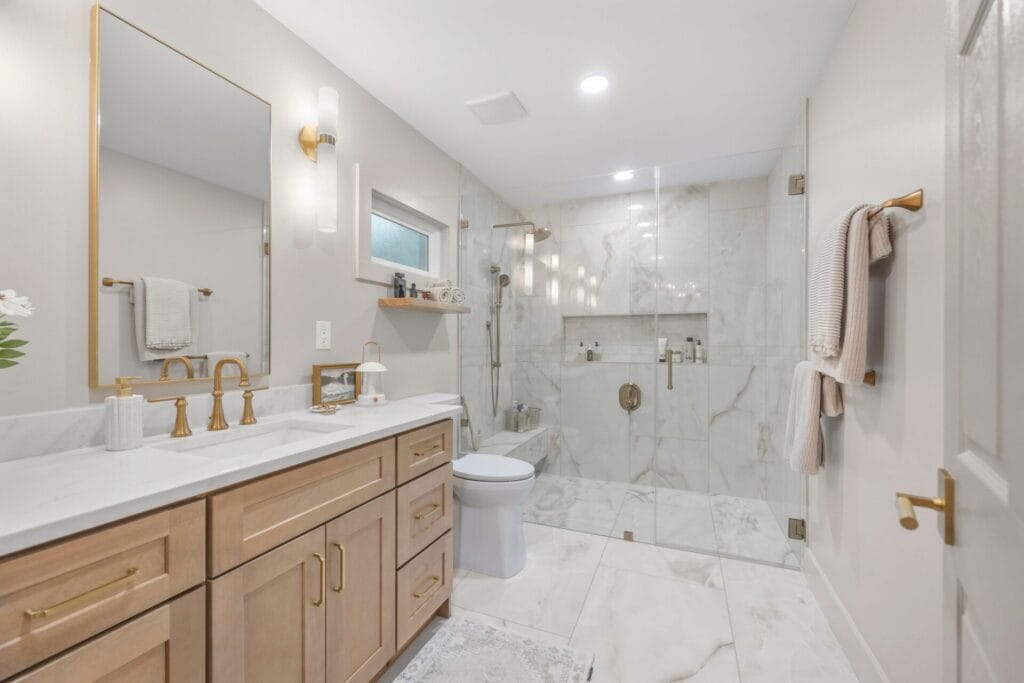
Porcelain is the workhorse of shower tile: dense, non-porous, and virtually impervious to water when properly installed. Large-format porcelain in particular has become the standard in well-executed primary suite showers in Charlotte, and for good reason. With fewer grout lines to maintain and a surface that reads as seamlessly refined, it delivers both performance and visual clarity.
Natural stone, marble, quartzite, limestone, brings a depth and warmth that porcelain can suggest but never fully replicate. The variation in veining, the way stone responds to light at different times of day, the weight it brings to a room; these are qualities that matter to homeowners who care deeply about how their space feels. The trade-off is maintenance: natural stone is porous and requires sealing, and some stones are more sensitive to acidic cleaners than others. In the right hands, with the right sealing protocol, it’s a material that ages beautifully. It’s a conversation worth having early in the design process.
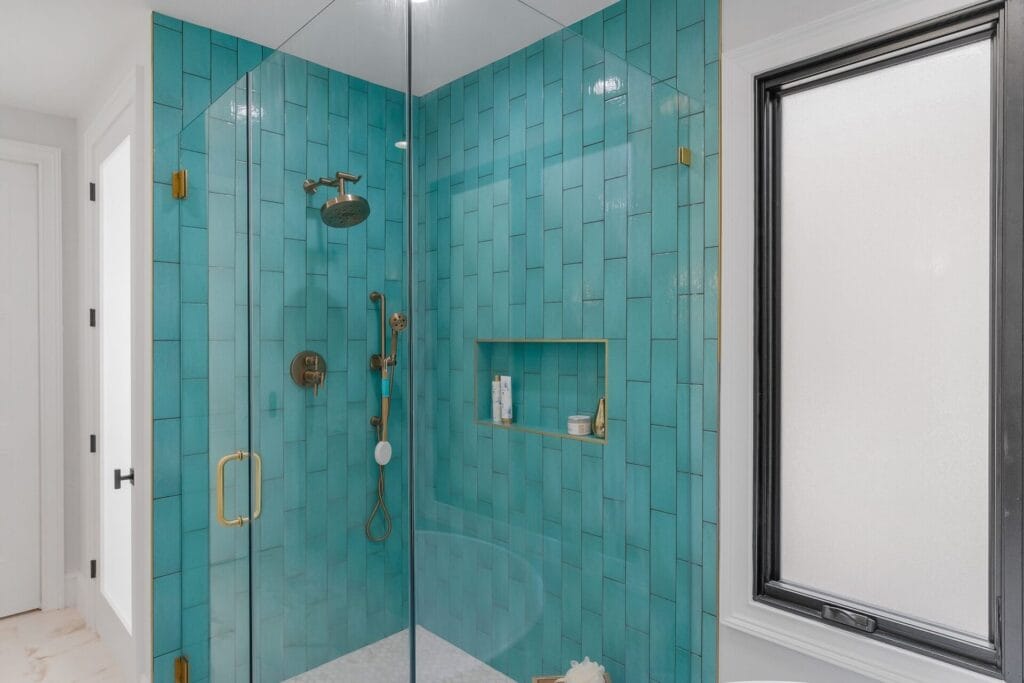
Zellige handmade Moroccan clay tile has become one of the most sought-after materials in elevated bathroom design over the past several years, and it’s showing up consistently in Charlotte primary suites. Its irregular surface, slight variation in color across tiles, and handmade quality give a room a character that no factory tile can reproduce. It rewards close attention and rewards even more from a distance. It also requires an experienced installer, the handmade variation that makes it beautiful also makes it unforgiving if the installation isn’t thoughtful.
Shower Floor Tile
The shower floor deserves its own consideration separate from the walls. Where walls are largely a design decision, the floor has a functional requirement that overrides aesthetics: slip resistance. Smaller tile formats, mosaic, penny tile, small hexagon, create more grout lines, which provide more traction. Larger format tiles on a shower floor require a honed or textured finish rather than a polished one. This is a detail that occasionally gets overlooked in the excitement of material selection and should be addressed explicitly during the design conversation.
Bathroom Floor Tile — Underfoot but Never an Afterthought
The bathroom floor sets the foundation of the room: visually and literally. It’s often the first surface the eye reads when entering, and it anchors every other decision in the space.
Continuity and Flow
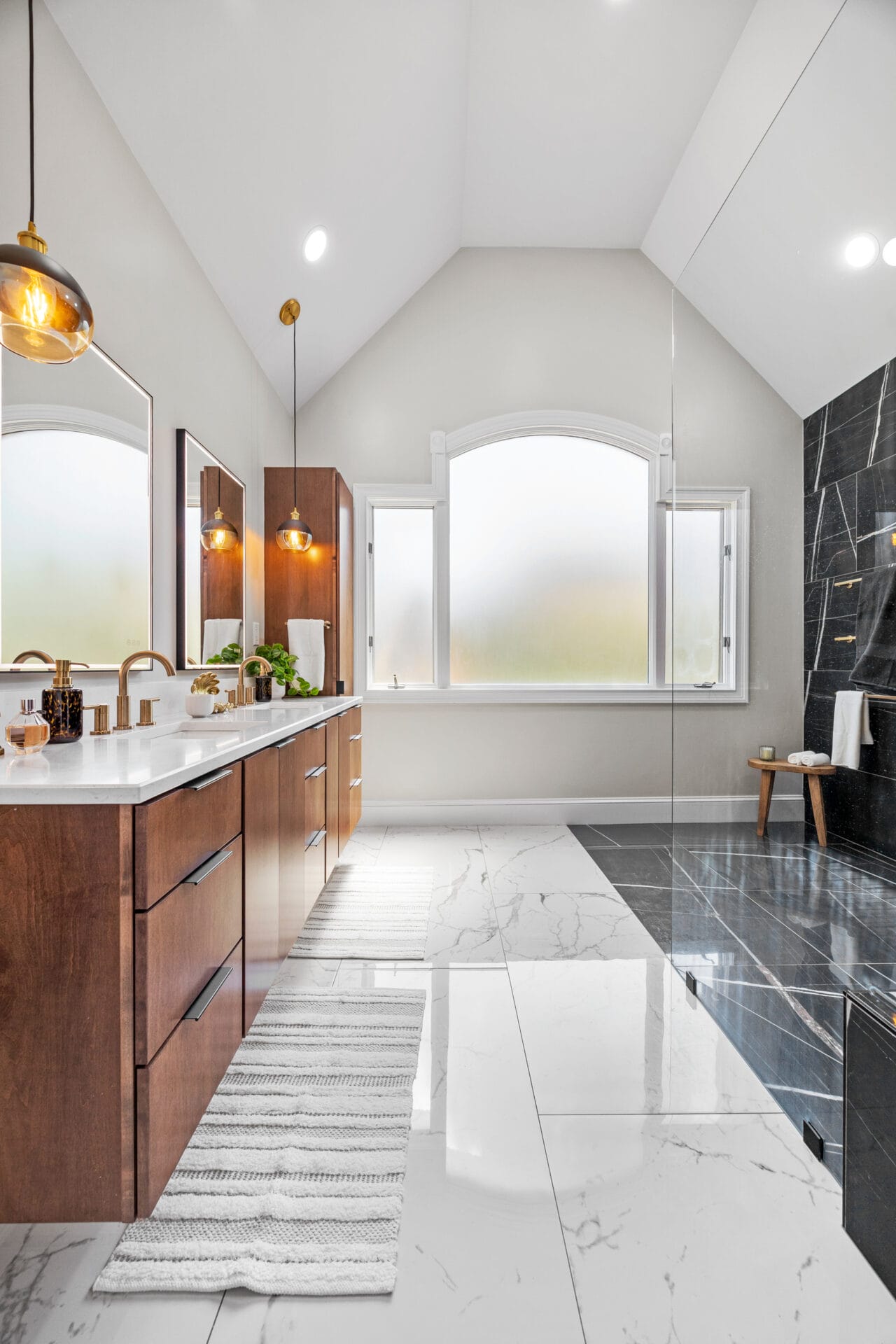
One of the most impactful decisions in a primary suite bathroom is whether to carry the same tile from the main floor into the shower, creating a continuous, uninterrupted surface. When done well, with a curbless entry and a linear drain, this approach makes the room feel significantly larger and more cohesive. The shower becomes an extension of the room rather than a separate compartment within it. It’s a detail that distinguishes a considered design from a standard renovation.
Scale and Proportion
Large-format floor tile 24×24 inches and above reads as refined and expansive. Fewer grout lines mean less visual interruption and a surface that’s easier to maintain. In a generously sized Charlotte primary suite, large-format porcelain or stone on the floor creates a foundation that feels genuinely luxurious without demanding attention.
Smaller formats have their place too. A handmade terracotta tile, a classic unlacquered stone, or a geometric cement tile on the floor can bring warmth and personality to a space in a way that large-format tile simply doesn’t. The key is that the choice feels intentional, that it’s in conversation with the rest of the room rather than at odds with it.
Heated Floors
In Charlotte’s winters, a heated floor beneath stone or porcelain tile is one of those details that homeowners who have it never want to live without. It’s worth building into the scope early, retrofitting it after the fact means pulling up the floor entirely. For a broader look at how selections like this affect overall project scope, see our home remodeling cost guide.
Wall Tile Beyond the Shower
Not every wall in a bathroom needs to be tiled but the walls that are tiled, and the ones that aren’t, should both feel like deliberate choices.
An accent wall behind a freestanding tub, carried floor to ceiling in a book-matched stone or a large-format porcelain with strong veining, can become the defining visual element of a primary suite. It’s a surface with presence; one that earns the attention it attracts.
In more restrained designs, a single material running from the shower into the adjacent walls creates continuity without visual noise. The tile does its job quietly, letting the fixtures and the light take the lead.
What to avoid is the half-measure, tile that stops at an arbitrary height, or a material that was chosen in isolation from the rest of the room. Every tiled surface should feel like it belongs exactly where it is.
Material Guide — Porcelain, Natural Stone, Zellige & More
Here’s a practical breakdown of the materials we work with most frequently in Charlotte bathroom remodels and what each brings to a project:
Porcelain — durable, non-porous, available in formats from small mosaic to large slab. The best porcelain today accurately mimics stone, concrete, and wood at a level that requires close inspection to distinguish. The go-to choice when performance and design range are both priorities.
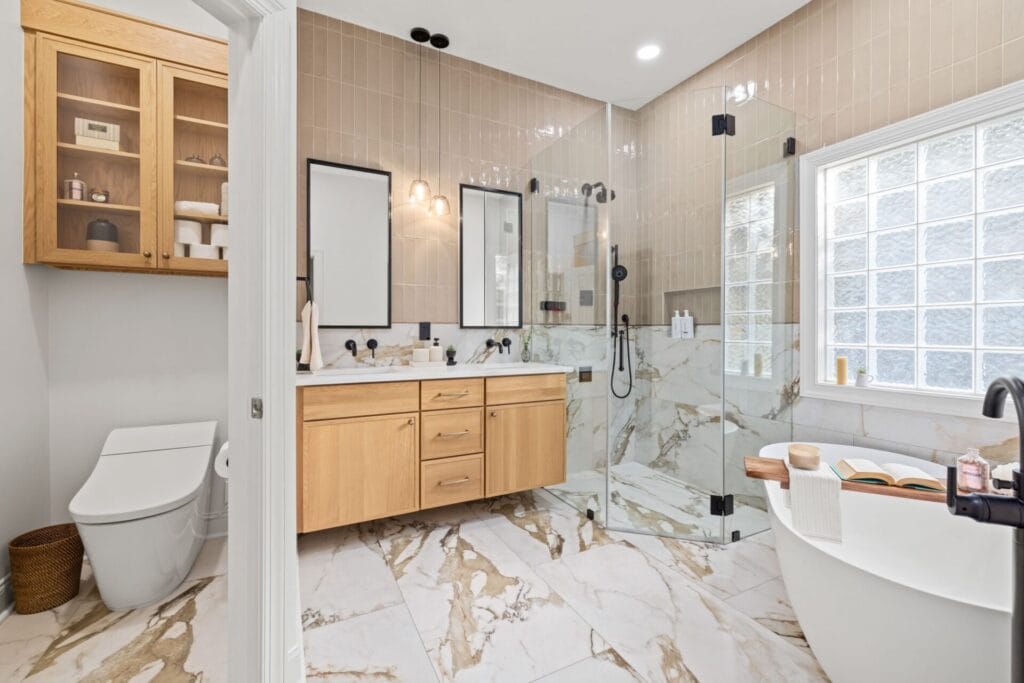
Marble — classic, timeless, available in hundreds of varieties from Calacatta to Statuario to Arabescato. Each slab is unique. Requires sealing and thoughtful maintenance. Ages with extraordinary character when cared for properly.
Quartzite — harder and more durable than marble, with similar visual richness. Often confused with marble at a glance but significantly more resistant to etching and staining. A strong choice for homeowners who want the look of stone without the maintenance sensitivity of true marble.
Limestone and Travertine — softer, warmer, and more organic in feel than marble. Brings a Mediterranean quality to a space. Requires sealing and should be used thoughtfully in high-moisture zones.
Zellige — handmade, irregular, deeply characterful. Best used where its handmade quality can be appreciated — a shower wall, an accent surface, a niche. Requires an experienced installer and a designer who understands how to use it with restraint.
Cement Tile — pattern-forward and bold. Best suited for floors or accent applications where its graphic quality can anchor a room without overwhelming it. Requires sealing and should be kept away from prolonged standing water.
Size, Layout & Grout — The Details That Define the Room
Two bathrooms can use identical tile and feel completely different depending on how that tile is laid and how the grout is handled. These details are not finishing touches, they are design decisions with real consequences.
Format and Layout
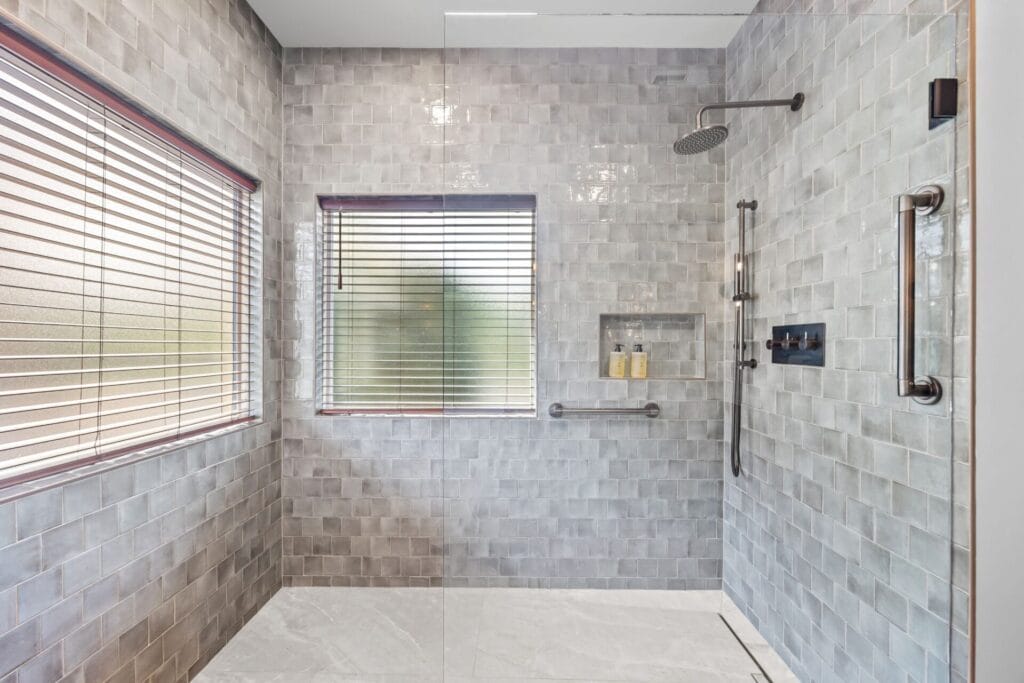
Vertical stacking of a rectangular tile draws the eye upward and makes ceilings feel taller. Horizontal running bond does the opposite, widening the room visually. A large-format tile laid in a straightforward grid reads as calm and modern. The same tile in a staggered offset reads differently. These are choices worth making deliberately.
Grout Color and Width
Grout color is one of the most underestimated decisions in a tile installation. A matching grout color tile and grout in the same family creates continuity and makes the tile surface read as unified. A contrasting grout, particularly a dark grout against a light tile, emphasizes the grid and makes a graphic statement. Neither is wrong, but both are definite choices with visual consequences that play out across the entire room.
Grout width matters too. Rectified tile, tile cut to precise dimensions, allows for very tight grout joints, sometimes as narrow as 1/16 of an inch. The tighter the joint, the more seamless and refined the surface reads. This is the standard in well-executed primary suite tile work.
The Linear Drain Decision
In a curbless shower, a linear drain along one wall allows the floor to slope in a single direction, which simplifies the tile layout considerably and allows large-format tile to be used on the shower floor without cutting awkwardly around a center drain. It’s a functional decision that also reads as a design detail, the kind of thing that distinguishes a thoughtfully designed shower from a standard one.
How Charlotte Homes Influence the Right Tile Choice
Charlotte’s architecture and interiors have a particular character that’s worth acknowledging. The homes in Myers Park, Eastover, SouthPark, and along Lake Norman tend toward warmth, natural materials, considered lighting, spaces that feel lived-in rather than staged. The cool, gray-heavy aesthetic that dominated the last decade is giving way to warmer tones: soft beige, clay, muted terracotta, organic greens, and the rich variation of natural stone.
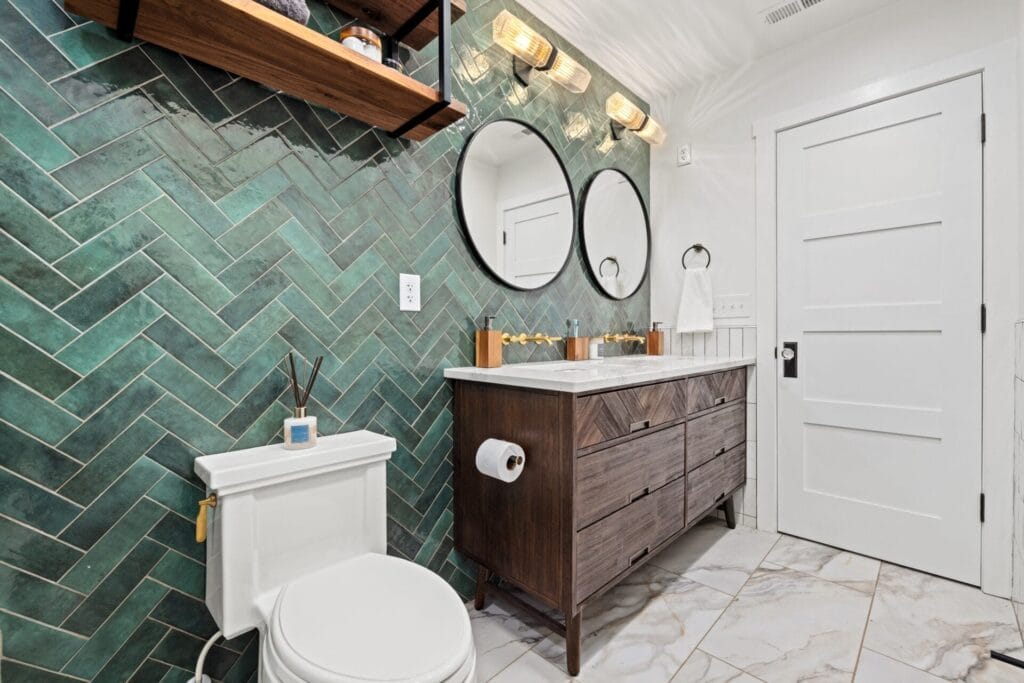
That shift is visible in the tile choices we’re seeing across Charlotte remodels in 2026. Warm-toned large-format porcelain, honed marble with visible movement, zellige in earthy neutrals, and limestone floors are all showing up consistently in primary suite renovations across the city’s established neighborhoods.
The other Charlotte-specific consideration is light. Many of the homes we work on have primary suites with specific orientations that affect how tile reads at different times of day. A cool white marble that looks extraordinary in a north-facing room with soft diffused light can read very differently in a south-facing suite flooded with afternoon sun. Sampling tile in the actual space, under the actual lighting, before finalizing a selection is something we consider non-negotiable on every project.
Frequently Asked Questions
What tile material is best for a primary suite bathroom in Charlotte?
There’s no single answer, the right material depends on the design direction, the layout, and how the homeowner uses the space. For most primary suite showers in Charlotte, large-format porcelain or natural stone are the strongest choices. Porcelain offers performance and design range. Stone offers depth and character that improves with age. The two are not mutually exclusive, many of the best rooms we build combine both.
How do I choose between porcelain and natural stone?
Porcelain is lower maintenance and more consistent in appearance. Natural stone is unique, alive, and develops character over time but requires sealing and more attentive care. For homeowners who value a material that improves with age and don’t mind the maintenance commitment, stone is deeply rewarding. For those who want beautiful, worry-free performance, high-quality porcelain is a serious contender.
Does tile selection affect the timeline of a bathroom remodel?
Significantly. Natural stone and specialty materials like zellige often have longer lead times than standard porcelain, and some materials are sourced internationally. Finalizing tile selections early in the design process before demolition begins is one of the most effective ways to keep a project on schedule. Last-minute tile changes are one of the most common causes of renovation delays.
Should the floor tile match the shower tile?
Not necessarily match, but they should be in deliberate conversation. Carrying the same tile from the floor into the shower creates continuity and makes the room feel larger. Using a complementary but distinct material on the floor can create intentional contrast and ground the room differently. What to avoid is a combination that feels accidental, two materials that neither match nor deliberately contrast.
How important is the tile installer in the final outcome?
Enormously. The most extraordinary tile selection in the world can be undermined by poor installation, uneven grout joints, inconsistent lippage, poorly planned layouts, badly executed cuts around niches and drains. The inverse is also true: a skilled tile installer can make a straightforward material selection look exceptional. This is one of the reasons we manage the full renovation process rather than leaving clients to coordinate tradespeople independently.
Ready to Talk Tile for Your Charlotte Bathroom?
Tile selection is one of the conversations we enjoy most with clients, it’s where the design starts to feel real. Whether you’re drawn to a particular material, working through how different options interact with your layout, or starting from scratch, we’re glad to work through it with you.
Browse our bathroom portfolio to see how tile has been used across a range of Charlotte primary suite and bathroom projects. When you’re ready to talk through your own space, our bathroom remodel team is here.
For broader context on what a Charlotte bathroom renovation involves from a scope and investment standpoint, our home remodeling cost guide covers the full picture. And if you’re working through finish decisions beyond tile, our roundup of top bathroom cabinet trends is worth a read alongside this one.